Introduction: When Softness Becomes a Biological Language
Soft skin is often described as a cosmetic ideal.
But beneath that simplicity lies a more complex biological reality. Softness is not merely a surface sensation—it is a structural outcome. It reflects how well the skin retains moisture, how evenly its surface cells align, and how intact its lipid barrier remains under environmental pressure.
When these systems function harmoniously, skin feels supple, elastic, and smooth to the touch.
When they do not, softness becomes fleeting.
Roughness emerges. Tightness develops. Texture becomes uneven and reactive.
The pursuit of soft skin is therefore not a pursuit of surface beauty alone. It is a pursuit of internal balance—hydration, barrier integrity, and controlled cellular renewal working in synchrony.
Within this framework emerges the idea of first aid beauty ultra repair cream Soft Skin Transformation Trick—a conceptual approach centered on accelerating the transition from compromised texture to resilient softness through targeted barrier reinforcement and hydration stabilization.
Not illusion.
Transformation.
The Anatomy of Soft Skin: What the Surface Really Reveals
Soft skin is not defined by a single factor.
It is the combined result of multiple biological systems working in alignment:
A hydrated stratum corneum.
A cohesive lipid matrix.
Controlled desquamation (cell shedding).
Minimal inflammation.
When any one of these systems becomes disrupted, softness declines.
The skin may still appear intact, but its tactile quality changes. It becomes uneven, less elastic, more prone to dryness or rough patches.
This is why soft skin is so sensitive to environmental and internal changes. It is a reflection of equilibrium—not a static trait.
The philosophy behind first aid beauty ultra repair cream Soft Skin Transformation Trick is built on restoring that equilibrium, rather than artificially masking roughness.
The Barrier: Architect of Texture and Feel
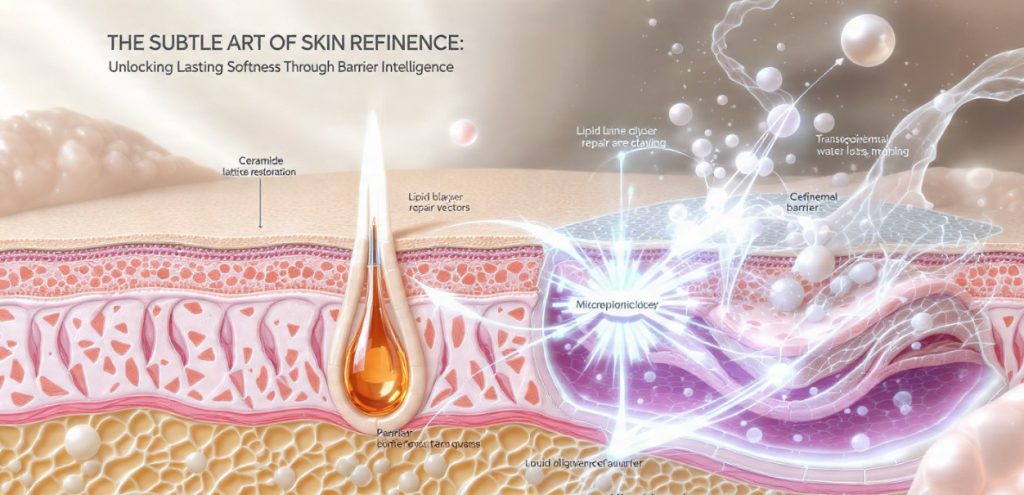
The skin barrier is the foundation of softness.
It consists of corneocytes (skin cells) embedded in a lipid matrix composed of ceramides, cholesterol, and fatty acids. This structure determines how much water is retained and how smooth the surface feels.
When intact, the barrier behaves like a flexible seal—strong enough to protect, yet adaptable enough to maintain comfort.
When compromised, gaps appear in this matrix.
Water escapes.
Environmental irritants enter.
Texture becomes uneven.
Softness diminishes.
A system like first aid beauty ultra repair cream Soft Skin Transformation Trick focuses on reinforcing this barrier architecture, improving cohesion between cells and restoring the structural foundation necessary for softness to emerge naturally.
Hydration as Structural Elasticity
Hydration is often misunderstood as simple moisture content.
In reality, hydration determines the skin’s mechanical flexibility.
Well-hydrated skin bends and moves smoothly. Dehydrated skin feels tight, rigid, and less responsive to movement.
However, hydration alone is not sufficient. Without barrier support, water evaporates quickly, leading to a cycle of temporary softness followed by rapid dryness.
The conceptual structure of first aid beauty ultra repair cream Soft Skin Transformation Trick integrates hydration delivery with retention support, ensuring that moisture is not only introduced but maintained.
This creates:
Improved elasticity.
Sustained smoothness.
Reduced roughness over time.
Softness becomes stable rather than temporary.
The Illusion of Softness vs Structural Softness
Not all softness is equal.
There is surface softness, created by temporary emollients that smooth the skin for a short period. And there is structural softness, which arises from a healthy, balanced barrier.
Surface softness fades quickly.
Structural softness endures.
The difference lies in depth.
Surface-level solutions coat the skin. Structural solutions repair it.
The philosophy behind first aid beauty ultra repair cream Soft Skin Transformation Trick prioritizes structural softness by addressing the biological systems responsible for texture rather than relying on temporary smoothing effects.
This distinction is critical for long-term skin quality.
Lipid Reinforcement: The Foundation of Smooth Texture
Lipids are the unseen architects of softness.
They fill the spaces between skin cells, ensuring cohesion and preventing uneven shedding. When lipid levels decline, the skin becomes rough, flaky, or uneven in texture.
Rebuilding lipid balance is essential for restoring tactile smoothness.
A formulation system like first aid beauty ultra repair cream Soft Skin Transformation Trick supports lipid reinforcement, helping restore the matrix that governs surface uniformity.
As lipid structure strengthens:
Texture becomes more refined.
Flaking decreases.
Elasticity improves.
Softness becomes more consistent across the skin surface.
The Role of Controlled Desquamation
Healthy skin sheds cells in a controlled, invisible process.
This ensures that new cells replace old ones evenly, maintaining a smooth surface.
When this process is disrupted, shedding becomes irregular. Some areas accumulate dead cells, while others shed too quickly.
This imbalance creates rough patches and uneven texture.
Restoring controlled desquamation is essential for achieving lasting softness.
The philosophy behind first aid beauty ultra repair cream Soft Skin Transformation Trick supports this process by stabilizing the barrier environment in which cell turnover occurs.
As regulation improves:
Surface texture evens out.
Roughness diminishes.
Skin appears more polished naturally.
The Sensory Shift: How Skin Feels During Transformation
Softness is not only visual—it is deeply sensory.
The transformation from rough to soft skin is often first noticed through touch:
A reduction in friction.
A smoother glide across the surface.
Less resistance during cleansing or moisturizing.
This sensory shift is an early indicator of structural improvement.
With continued use of first aid beauty ultra repair cream Soft Skin Transformation Trick, this tactile improvement becomes more pronounced and stable, signaling deeper barrier recovery beneath the surface.
Comfort becomes measurable through feel.
Environmental Stress and Texture Disruption
External conditions play a significant role in disrupting softness.
Cold air reduces natural oil production. Dry climates accelerate water loss. Pollution introduces oxidative stress that weakens barrier integrity. Indoor heating systems strip humidity from the environment.
Each of these factors contributes to texture irregularities.
Over time, they create a cumulative effect:
Skin becomes rougher.
Softness diminishes.
Barrier resilience weakens.
A stabilizing system like first aid beauty ultra repair cream Soft Skin Transformation Trick acts as a protective buffer, reducing the impact of environmental stressors on skin texture.
The goal is not isolation from environment.
It is adaptation within it.
The Hydration-Retention Loop: Key to Lasting Softness
Soft skin depends on a continuous hydration-retention cycle.
Water must enter the skin.
It must be retained effectively.
It must be balanced with lipid support.
If any step fails, softness becomes inconsistent.
The conceptual structure of first aid beauty ultra repair cream Soft Skin Transformation Trick strengthens this loop by reinforcing both hydration input and barrier retention capacity.
This dual support ensures that softness is not dependent on constant reapplication but is maintained internally.
Stability replaces fluctuation.
The Psychology of Soft Skin Perception
Soft skin has psychological effects beyond physical sensation.
It influences confidence, self-perception, and comfort in personal appearance.
When skin feels rough or uneven, attention often turns inward, focusing on texture rather than expression. When skin feels soft and balanced, attention shifts outward again.
This shift is subtle but significant.
The stabilizing effect of first aid beauty ultra repair cream Soft Skin Transformation Trick contributes to this psychological transition by restoring tactile and visual harmony.
When skin feels consistent, perception becomes lighter.
Overnight Transformation: The Skin’s Natural Repair Window
Nighttime is the most active period for skin regeneration.
During sleep, cell turnover increases. Barrier repair accelerates. Hydration regulation improves.
This makes nighttime the ideal window for texture transformation.
Applying first aid beauty ultra repair cream Soft Skin Transformation Trick during this period supports natural repair processes, enhancing hydration retention and barrier rebuilding.
Overnight, the skin moves closer to structural balance.
By morning:
Texture feels smoother.
Softness increases.
Surface irregularities are reduced.
Sleep becomes a transformation cycle rather than a passive state.
Consistency: The Engine Behind Long-Term Softness
Soft skin is not achieved through a single application.
It is built over time.
Each application contributes to barrier reinforcement. Each cycle of hydration improves structural integrity. Each day of support reduces cumulative texture damage.
With continued use of first aid beauty ultra repair cream Soft Skin Transformation Trick, the skin transitions gradually:
From rough to refined.
From uneven to balanced.
From fragile to resilient.
Consistency turns temporary softness into lasting transformation.
Simplicity in Soft Skin Strategy
Overcomplicated skincare routines can interfere with skin balance.
Excess exfoliation disrupts the barrier. Too many actives increase sensitivity. Conflicting ingredients can destabilize hydration levels.
Soft skin thrives in simplicity.
A focused system like first aid beauty ultra repair cream Soft Skin Transformation Trick reduces unnecessary complexity while supporting essential repair mechanisms.
Minimal disruption.
Maximum restoration.
Clarity over complexity.
The Transformation Curve: How Softness Develops
Soft skin does not appear instantly—it follows a progression:
Initial phase: hydration increases, tightness decreases.
Early transformation: rough patches soften.
Mid-stage: texture becomes more uniform.
Final stage: softness stabilizes across the skin surface.
This transformation curve reflects underlying biological repair.
The role of first aid beauty ultra repair cream Soft Skin Transformation Trick is to support each stage efficiently, accelerating progression without disrupting natural skin function.
Conclusion: Softness as a Sign of Skin Intelligence
Soft skin is not an aesthetic accident.
It is the result of biological intelligence functioning properly—hydration balance, lipid cohesion, controlled cell turnover, and environmental adaptation working together in harmony.
When these systems fall out of sync, softness fades.
When they are restored, softness returns—not superficially, but structurally.
The philosophy behind first aid beauty ultra repair cream Soft Skin Transformation Trick reflects this understanding of skin as a dynamic, self-regulating system.
It does not impose softness.
It restores the conditions that allow softness to emerge naturally.
When balance is achieved, skin transforms.
Texture refines.
Comfort stabilizes.
And softness becomes not a fleeting sensation, but a consistent expression of healthy, resilient skin.
You may also like
-
Structured Data and Beauty Discovery: Making Online Advice Easier to Trust
-
The Beauty & Skincare Glow Shift: How Tiny Tweaks Can Unlock Your Skin’s Hidden Brilliance
-
The Beauty & Skincare Glow Equation: How to Balance Ingredients, Lifestyle, and Science for Skin That Shines
-
The Beauty & Skincare Glow Matrix: How to Sync Your Routine with Your Skin’s Natural Rhythm
-
The Beauty & Skincare Mindset: How Psychological Shifts Can Unlock Your Skin’s Full Potential